How OpenFlows compares
Every AI tool writes code. They differ in where the human sits. OpenFlows is a self‑hosted, governed, agent‑first team — not a chat assistant, not a hosted autonomous coder, and not a bare orchestrator. AI writes code faster than any team can consume it, so review — not writing — is the bottleneck. The first pass of that review must be done by another agent before a human ever sees anything, and OpenFlows moves humans up the chain to architecture and product ownership. This page compares that to the alternatives.
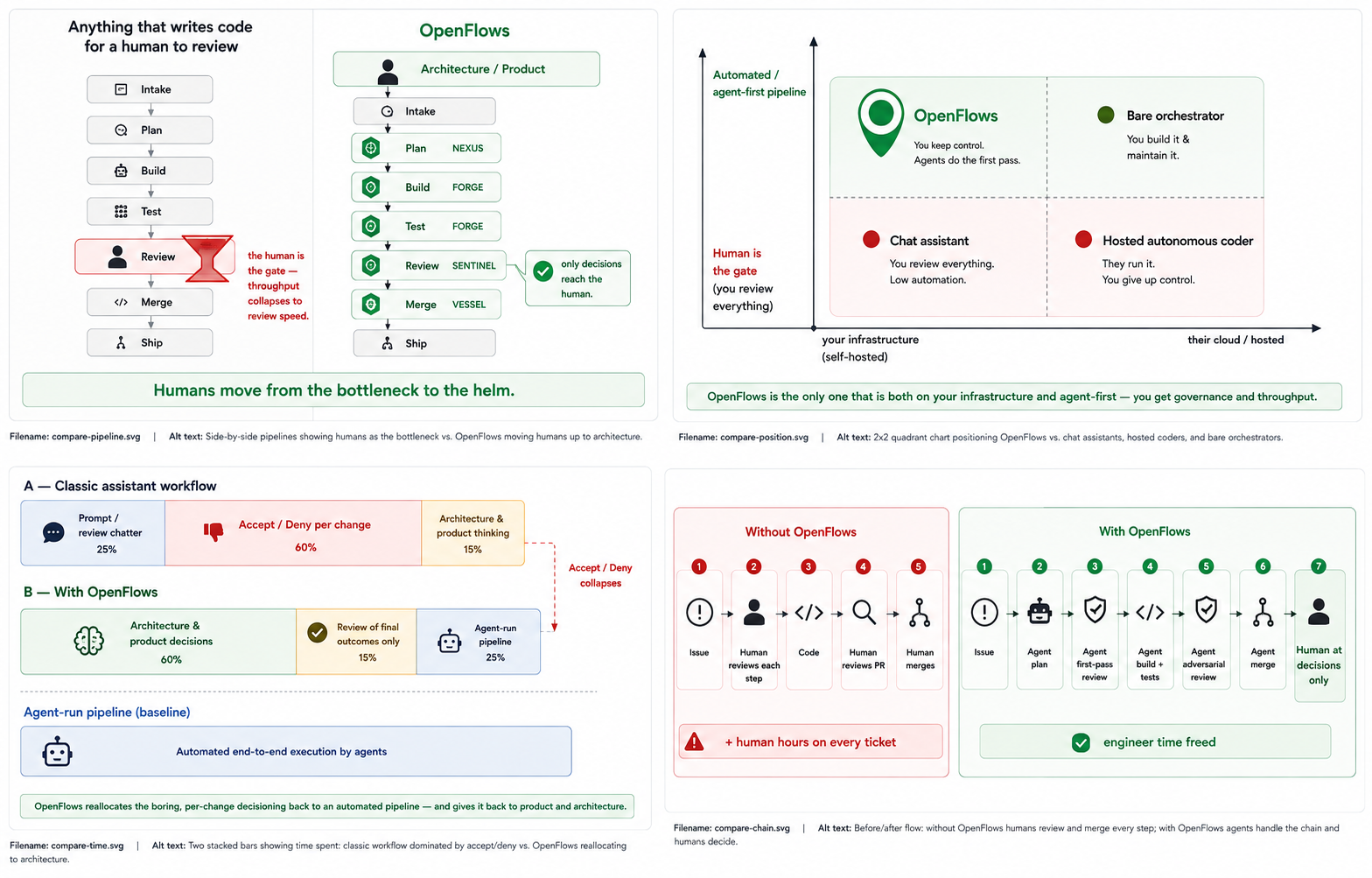
Where humans sit in the pipeline
Throughput collapses to review speed.
Only decisions reach the human.
The position map
The short version
| Approach | Where it runs | Who reviews the work | Key trade-off | Recommended when |
|---|---|---|---|---|
| OpenFlows | Your own Coder environment | An isolated adversarial AI reviewer | Governance and audit with agent‑first throughput | Enterprises, teams, and solo devs who want governed, automated delivery on their own infrastructure |
| Chat assistant | Your machine / hosted | You | Fast and familiar, but you do the review and there are no team guardrails | Individuals who want help typing, not a team that runs |
| Hosted autonomous coder | Their cloud | Their pipeline | Zero‑infra convenience, but work, keys, and code leave your control | Teams that accept running on a third‑party cloud |
| Bare orchestrator | Your infrastructure | You build it | Full control, but you write and maintain the coordination logic | Teams that want to build and own their own coordination |
| Just Coder | Your Coder environment | You | You get workspaces and models, but no autonomous planning/review/merge | Teams that already run Coder and want to stay human‑driven |
The trade-offs, one by one
OpenFlows vs. a coding chat assistant
Both are powered by language models writing code. The difference is process — and whether the human is the bottleneck.
- Chat assistants are a tool you operate. You prompt, you review, you accept. Because the assistant can write code faster than you can review it, you become the limiting step — every change funnels through your judgment, so the pipeline slows back down to human speed and costs you hours of accept‑or‑deny clicking.
- OpenFlows is a team that operates itself. It plans before coding, gives every change a first‑pass review by another agent, and escalates to you only for genuine decisions — so you move up the chain to architecture and product, not down into the review queue.
Best for: when you want AI to execute end‑to‑end with guardrails, not just help you type.
OpenFlows vs. a hosted autonomous coder
Both automate coding end‑to‑end. The difference is where it runs and who can audit it.
- Hosted agents run in their cloud. Code, prompts, and outputs leave your network; you rely on their security and their review process, and you cannot fully audit.
- OpenFlows runs in your own Coder control plane. The model calls go through your gateway, every step is your auditable record, and worker workspaces hold no keys by design.
Best for: regulated companies and anyone who cannot or will not send code to a third‑party cloud.
OpenFlows vs. a bare orchestrator
Both automate a multi‑step agent pipeline. The difference is how much you build and maintain.
- A bare orchestrator gives you a flow that you author and debug yourself — routing, retries, state, and recovery are all your responsibility.
- OpenFlows ships the coordination as a product: a typed shared store, a gated planning cycle, adversarial review, self‑healing reconciliation, and human escalation — all already built.
Best for: teams that want the engineering of the coordination handled, not reinvented.
OpenFlows vs. Coder alone
Coder is the substrate; OpenFlows is what runs on it.
- Coder alone gives you governed, disposable workspaces and a model gateway — an excellent place for humans to work.
- OpenFlows adds the team. It provisions those workspaces, assigns one agent per ticket, coordinates their hand‑offs, and drives the work to a reviewed merge.
In OpenFlows' own framing: Coder governs where agents run; OpenFlows governs how they coordinate. This separation is the whole architecture.
Where the time goes
Your chain vs. the OpenFlows chain
- Issue
- Human reviews each step
- Code
- Human reviews PR
- Human merges
+ human hours per ticket
- Issue
- Agent plan
- Agent first‑pass review
- Agent build + tests
- Agent adversarial review
- Agent merge
- Human at decisions only
engineer time freed
The trade-offs to weigh
- OpenFlows requires Coder. It is not a standalone tool; it rides on your self‑hosted Coder environment. If you don't have (or don't want) that infrastructure, it isn't the right starting point.
- It favors governance over raw speed. The planning gate and adversarial review add steps. That is the point — they are the source of the audit trail and the quality ceiling — but for trivial, throwaway changes they are more ceremony than you might want.
- Setup is non‑trivial. Installing it means standing up the control plane, provisioning a tenant, and linking GitHub OAuth.
Humans are moved, not removed. OpenFlows still hands you the architecture and the final decision — you own the product, the direction, and what ships. What it removes is the per‑change accept/deny bottleneck, not the engineer.