
The Workspace Fleet
The workspace fleet is the collection of Coder workspaces OpenFlows provisions and supervises to actually get work done. It comes in two flavors: one long-lived orchestrator workspace and many short-lived worker workspaces.
The two kinds of workspace
The NEXUS (orchestrator) workspace is long-lived and trusted. It runs the Controller brain. It is the only workspace that legitimately holds credentials and talks to Coder’s API. Think of it as headquarters.
Worker workspaces are short-lived and disposable — one per agent per ticket. They are created when work is assigned and torn down when it completes. Think of them as temporary job sites.
Inside a worker workspace
A worker workspace contains only what its one agent needs to do its one job:
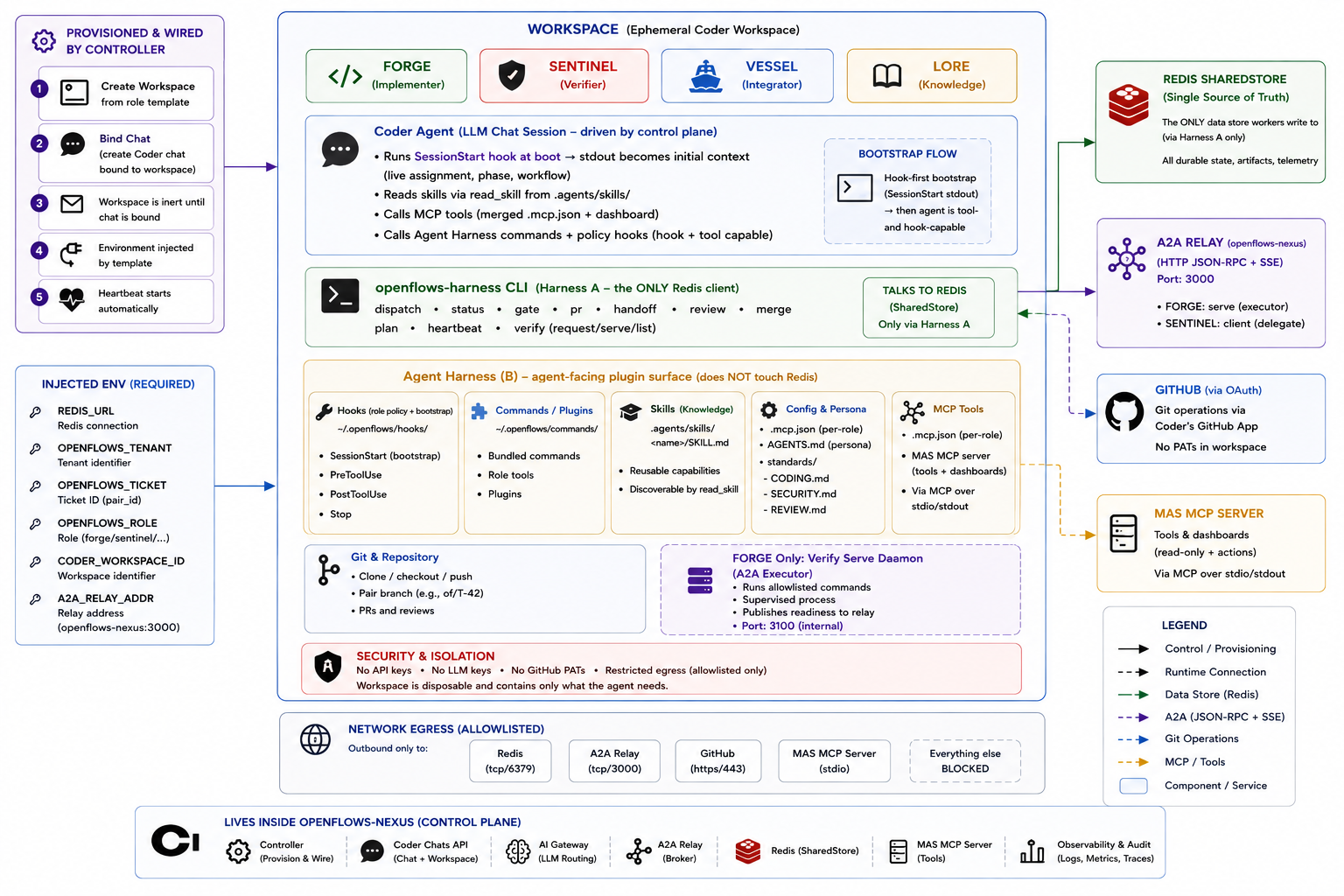
- The coordination command surface (how the agent reports progress and reads its task).
- The repository checkout, on the branch the agent is working on.
- The role’s skills, standards, and persona.
And deliberately nothing more:
- No LLM API keys — all AI calls are routed through the central gateway in the control plane.
- No raw repository credentials — git identity comes from a scoped OAuth link.
- No agent framework — the intelligence runs centrally; the workspace hosts the surface.
Lifecycle of a worker workspace
- Provision. The Controller creates the workspace from the role’s template.
- Boot. The workspace installs its coordination tooling, gets the repository, and starts a liveness beacon.
- Bind task. The Controller attaches the specific ticket and role to the workspace.
- Work. The agent does its job, reporting through the coordination surface.
- Record. Durable results are written to the coordination store.
- Tear down. On merge, the workspace is deleted and its liveness beacon removed.
Why workspaces are isolated
The isolation between workspaces is what makes the system’s central promise — trustworthy adversarial review — hold:
- FORGE and SENTINEL never share a filesystem. The reviewer cannot reach into the builder’s tree.
- The reviewer only interacts with the builder’s code by requesting a safe command and reading the returned evidence.
- Each tenant’s workspaces are invisible to other tenants’.
Liveness: knowing who’s alive
Each worker keeps a liveness beacon: a small, self-expiring record refreshed on a cadence. If the beacon stops updating, it expires on its own, which tells the Controller "this workspace has gone silent." No external watcher needs to poke every container.
When a workspace goes silent, the Controller declares it stale and recovers it — tearing it down, re-provisioning a replacement, and re-assigning the ticket — up to a bounded number of attempts before escalating to a human.
The overall security posture
Taken together, the workspace fleet embodies the security-by-design idea:
- Trusted, credential-holding component: one long-lived orchestrator workspace.
- Everything else: disposable, keyless, credential-free, tightly firewalled.
- No shared files, no shared keys, no anonymous identities.
Why it’s governed: the fleet makes safety structural