Don’t Build on Vibes. Build on Architecture.
AI can generate code quickly, but reliable software needs more than suggestions. OpenFlows helps teams turn architectural intent into governed, secure, production-ready delivery.
- Christian Yemele

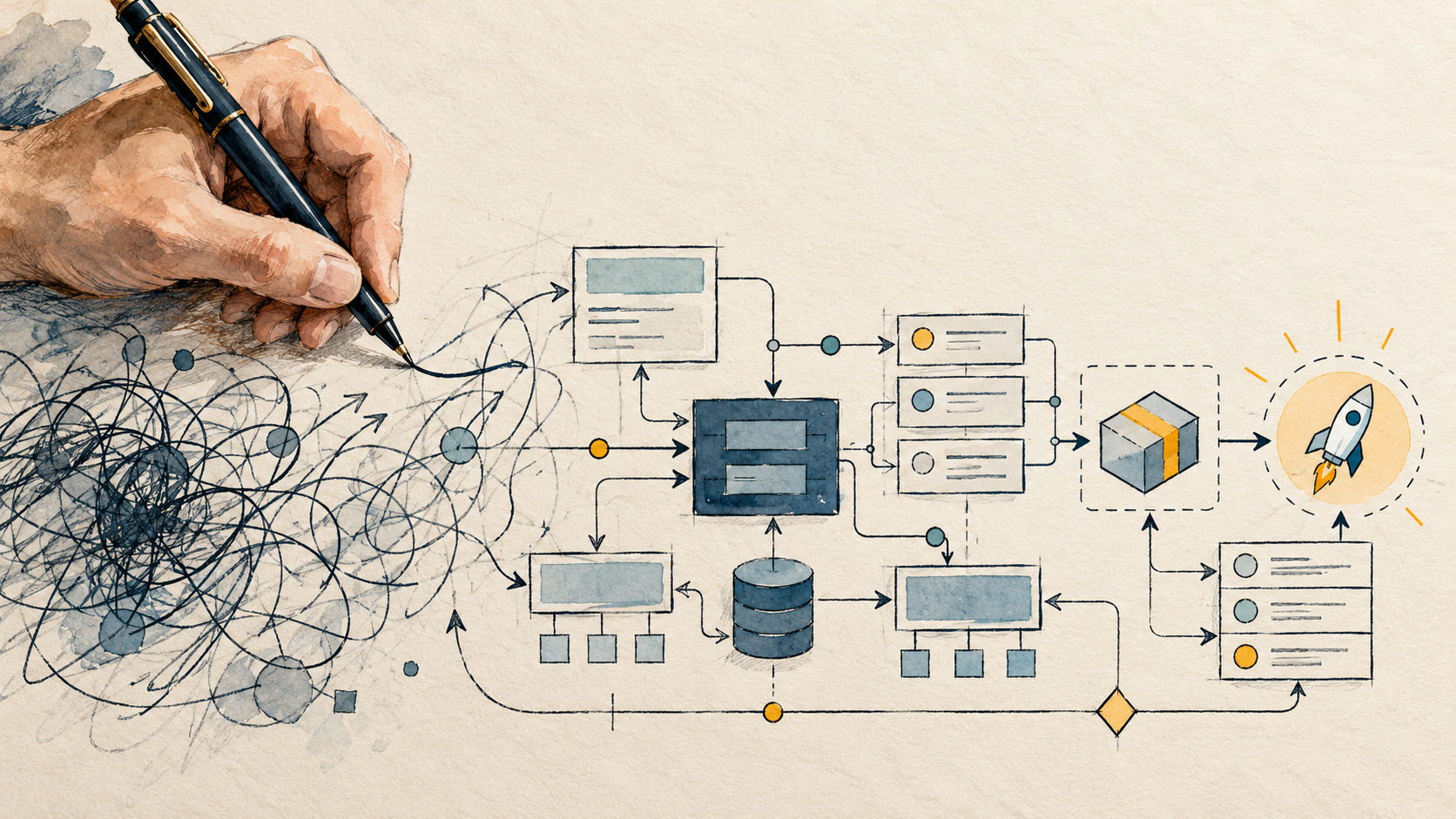
AI has made writing code faster than ever. That is useful, but it has also created a risky habit: building software from prompts, vibes, and whichever suggestion an AI produces next
A feature request becomes a chat. A chat becomes code. Code becomes a pull request. Somewhere along the way, the architecture disappears.
The result may feel productive at first. Without deliberate design, however, teams inherit inconsistency, fragile integrations, unclear ownership, security gaps, and systems that become harder to evolve with every release.
Software is not only code generation. It is architecture, decisions, boundaries, workflows, security, product intent, and accountability.
That is why OpenFlows exists.
Own the architecture. Own the software.
OpenFlows is built on a simple principle: you should own your architecture, your software, and the way it is produced.
You define the direction. You impose the design. You choose the constraints, standards, technology, security posture, and engineering practices that matter to your organisation.
OpenFlows then turns that direction into delivery.
Instead of asking an AI to build something nice, you interact with a governed system. Think of it more like working with a compiler than gambling with a chatbot. You provide the inputs, rules, and architectural intent. OpenFlows coordinates the work needed to produce an implementation that follows them.
Your architecture becomes the source of truth. Your software is the output.
From AI suggestions to engineered delivery
AI suggestions are easy to get. Engineering discipline is harder.
A generic coding assistant can propose code, explain an API, or generate a component. It does not automatically understand your domain boundaries, your team’s conventions, your deployment model, your security controls, or the trade-offs behind a technical decision.
Those things must be designed.
OpenFlows brings agentic development into an architecture-first workflow. It coordinates specialised AI roles across planning, implementation, testing, review, and verification, inside controlled development environments and existing engineering workflows.
The goal is not to remove engineers from the process. The goal is to reduce the friction between architectural intent and reliable software delivery.
With OpenFlows, teams can:
- Define work through their existing GitHub workflow.
- Establish architecture and engineering constraints before code is written.
- Use planning and review checkpoints to keep work accountable.
- Run AI agents in isolated, governed environments.
- Produce reviewed pull requests rather than disconnected snippets of code.
- Keep humans in control of the decisions that shape the product.
This is how AI becomes useful at scale: not as an uncontrolled source of suggestions, but as a system that executes within a design you own.
Your design. Your pace. Your taste.
Every engineering organisation has its own way of building. Some value speed above all else. Others operate under strict security, compliance, or infrastructure requirements. Some need strong architectural governance across multiple teams. Others want to move quickly without losing the quality that makes future growth possible.
OpenFlows is designed for that reality.
You choose the design. You determine the pace. You set the standards.
Whether your approach is pragmatic and lightweight or highly structured and controlled, the system should serve your engineering culture. It should not replace it with someone else’s assumptions.
That is what makes agentic development compatible with real software architecture. Architecture is no longer a document that becomes outdated. It is an active constraint on how software is planned, built, tested, reviewed, and shipped.
Automated does not mean uncontrolled
The future of software development is not an AI agent with unrestricted access to production systems. It is an automated delivery system with clear boundaries.
OpenFlows supports that model with isolated workspaces, defined responsibilities, planning gates, adversarial review, auditable workflows, and a clear separation between the environment where work runs and the flow that governs how agents collaborate.
Automation should increase confidence, not reduce it. Governance should enable speed, not become bureaucracy. Security should be part of the delivery model, not an afterthought once code has been generated.
When those pieces work together, teams move faster because they no longer have to choose between velocity and control.
Ship faster without surrendering the system
The promise of agentic development is not simply that code can be written faster. The real promise is that teams can shorten the distance between a well-considered decision and a production-ready change.
OpenFlows helps make that possible.
You own the architecture.
You own the software.
You impose the design.
OpenFlows helps produce the result at your speed, with your standards, and according to your taste.
Comments
Questions, feedback, or thoughts? Comment below and join the discussion on GitHub.